Almost Shipwrecked On Mjojo

Back in the 60’s of the last century Lotty (my wife) and I lived on a superb African built wooden Gaff Rig Cutter called Mjojo (the Swahili diminutive of Josephine, the builder’s daughter) of about 42 foot length.

A superbly sea worthy boat which had already sailed almost all the way around the world when we bought her from her builder – an amazing sailor called Rod Pickering.

images007

One day, on what was intended to be a pleasant day’s sail out of Newhaven, with Lotty, myself and a friend from the Roundhouse, Mike Waterman, we found ourselves in serious danger of being thrown onto the rocks and drowning.

Before setting out, we had (of course) listened to the shipping weather forecast, which promised us reasonably strong winds and clear visibility.  So, we cast off from the inner harbour of Newhaven (which for you non-Brits, is a fishing port on the south coast of England) and set out for a pleasant day on the English Channel.

After about an hour’s enjoyable sailing straight out to sea, the weather began to change, the wind getting stronger and stronger.  I listened to the shipping forecast again, and it was now telling me that we were about to be enveloped in a Force 12 to 14 storm.

Hmmmmm…….

Force 14?   What was that in God’s name?   I had never heard that there was anything stronger than force 12, but apparently it did go up to 14, which effectively was a hurricane…

We thought we probably had time to turn around and get back to the shelter of Newhaven harbour, so we duly turned about and headed for shore and we hoped, safety.

But luck was not with us, and the wind got stronger by the minute, and wasn’t in a good quarter for us to sail our remarkably heavy (24 tons) Gaff Rig cutter.   On top of which, the wind, which was blowing away from the shore, and thus more or less coming from where we were trying to sail to, the tide was also coming in, so we found ourselves in the unpleasant situation of wind over tide, which apart from any other effect, causes the waves to get higher and higher, as the wind tries to push the sea in the opposite direction to the tide.

Continue reading “Almost Shipwrecked On Mjojo”

Travelling With Charlie Watts

Many years ago, around 1966 I was a student at St Martin’s School of Art (as it was called in those days) which is in Charing Cross Road, London.   Immediately opposite is Denmark Street, a small street where loads of music companies used to have their offices.

OK, so why the guided tour of London you ask?   Well simply enough, it is because among others, the Rolling Stones who were beginning to be very famous had an office there as well, so we saw a lot of the band as they went about their affairs there.

At the time I lived in a suburb of London called Brixton, which I travelled to and from via the London Underground every day, and it so happened that Charlie Watts also lived down that way, thus he frequently used the underground to get to and from home, and he and I used to chat about life and such things as we went home of an evening.   Very nice guy, by the way.

hqdefault

Anyhow, the point of this farrago is the way other travellers reacted to seeing Charlie Watts sitting there.   People sort of gazed at him, did double takes, but simply couldn’t believe it was really him, as of course, Rock Stars do not travel around in the underground – They travel in huge limos with body guards and so on……

For his part, Charlie Watts simply ignored everyone and behaved as if it was a perfectly normal thing for him to be on the underground, reasonably enough, and didn’t react to their stares.

In due time most people simply assumed it was a young man who looked remarkably like Charlie Watts and left it at that – But it was Charlie Watts.

Water Music – Whores, Thieves, Sex, Clarinets

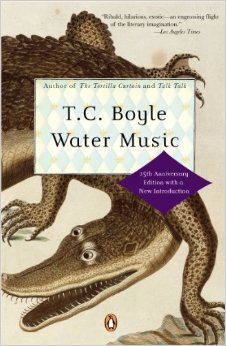
I have just finished reading a very strange book, Water Music by T.C. Boyle, an author I had never heard of, but found to be an immensely enjoyable read.

In the publisher’s blurb, they give an idea of what it is about:-

A funny, bawdy, extremely entertaining novel of imaginative and stylistic fancy that announced to the world Boyle’s tremendous gifts as a storyteller. Set in the late eighteenth century, Water Music follows the wild adventures of Ned Rise, thief and whoremaster, and Mungo Park, a Scottish explorer, through London’s seamy gutters and Scotland’s scenic highlands—to their grand meeting in the heart of darkest Africa. There they join forces and wend their hilarious way to the source of the Niger.

51Py6QyoYJL._SY344_BO1,204,203,200_

Whilst to a degree, this is a realistic description of this book, it falls far short of the complex reality of the book.  This book starts of as a humerous look at the mixed up world of 18th Century Britain, drawing contrasts between urban and rural life in those days, and we are treated to a no holds barred look at the god awful life that most people led in those unsavoury days.

We are also introduced to the world of exploration, as the Great Powers of the time – France, Britain, Germany et.al struggle to take over the rest of the world, and in this case, Africa. Specifically trying to find the fabled river, the Niger. This river is used as a sort of symbol for all that the white people hoped to extract from Africa – wealth, power and slaves.

Continue reading “Water Music – Whores, Thieves, Sex, Clarinets”

Rolling Down A French Hill, With Geese!

While I was working at the Roundhouse, a friend of mine, Robbie Simpson, the guy who had got me the job at the Roundhouse, left England and went to live with his French girlfriend in the hills near to Orange, on a lavender farm.   As one does.

So on a fine summer’s day I went down there to visit them, and had an experience I would happily have missed, namely rolling down a French hillside in a car full of geese.

We were heading to see a friend of his to give them a couple of rather large and vociferous geese in Robbie’s small Citroen Dyana, when as we were rounding a rather sharp corner on a mountain road, we met a car coming the other way in the middle of the road….

This is the hillside we went rolling down....
This is the hillside we went rolling down….

Robbie braked and swerved to avoid a head on collision, but sadly, as is all too often the way in rural France, the road was covered in fine gravel.. So we simply slid over the edge of the road and went rolling down the hillside, turning over and over as we went.

All rather confusing, and made tricky by having those geese tumbling all over the place as we went.   Luckily we were rolling relatively slowly, and finally came to rest upside down in a field at the bottom of the hillside.  I found myself hanging upside down with a large and infuriated goose between me and the roof of the car, not a good place to find oneself, as they have large and active wings, and very serious beaks….  So extra pain was the result of that dammed goose.

After sitting there for a few seconds, somewhat dazed, we scrambled out of the car, releasing the geese as we did so.   They had been stuffed into two large brown paper bags for transport, but in the course of our undignified rolling down the hillside, had escaped from those bags…  So they went rushing off to get as far from both the car and us as they could – understandably I suppose.

Cesária Évora – A Great Cape Verdean Singer

I am sitting here, listening to an amazing concert on good old Youtube.  It is A full concert of the superb Cape Verdean singer Cesária Évora – apparently also known as the Barefoot Diva owing to her habit of performing with bare feet.   Be that as it may, this unremarkable looking, dumpy small woman, at the time the concert I am watching was recorded, was in her 60’s and yet had the voice of a woman in the full flowering of her youth.   A wonderful warm and gentle voice she had.

cesaria-evora-461452-jpg_311617

Sadly she died in 2011, but before that she had an amazing career as a singer.

Not really much to be said about her, except click on the link below, sit back and enjoy listening to, and watching a real artist at work…  And be glad that in reality it is not necessary for a woman singer to behave like a cross between a pole dancer and a stripper to be a success.

https://youtu.be/oWYKTiqPvYA

Share with us:

If you did sit back and give this amazing woman – and her equally superb band – the attention that was her due, and enjoyed it too please share any thoughts you might have about her with us here.

Borneo – Strange Place – Strange Reminders Of Time Past

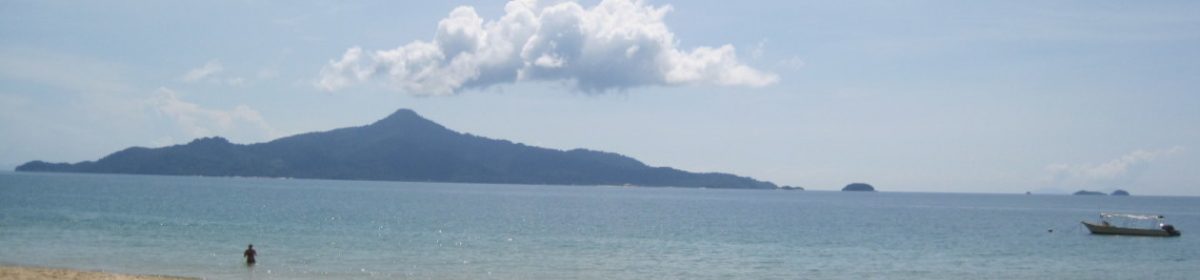
Recently my wife had work for the Malaysian Ministry of Education, which entailed her dashing around Malaysia like a mad thing – a few days here, a few days there.  I accompanied her on her peregrinations of course, even though I had retired by that time, so I was a gentleman of leisure, and happily passed my time in these places writing a blog I had in those days, and gently absorbing the pleasures of the places we were in.

Two of these places really appealed to me – for different reasons.

Kutching:  Singapore as it was.

The first was Kutching in Sarawak.   A small but active little city on the banks of a river.  I was wandering around it on my first visit there, and had a strong feeling of deja vu, which to begin with I couldn’t understand.

Kuching Street Scene

And then it came to me.   Kutching today is almost exactly how Singapore was in 1950 when I lived there.   Generally low buildings, very dirty and cheerfully chaotic, each ethnic group living and working in their own section of the city and the greater part of the street commerce taking place on the street rather than closed-off in shops.   It was a strange and mildly disturbing experience finding myself back in the word I had lived in when I was about 9 years old.

And it brought home to me strongly how much Singapore has changed since it belonged to us Brits.   For the better?   Not sure.  In some ways, certainly, but at the cost of the loss of its character I feel.

Labuan – Small but fine

The other place that intrigued me was the small island of Labuan, which is off the north western tip of Borneo, and is chiefly notable for being a free port and for being in the middle of an oil field.

The first means that it is full of “duty free” shops, so a great place to buy booze and smokes, the second means it is entirely surrounded by drilling rigs and full of oil workers of all nationalities.

It also had it curious characters too.  We stayed in one hotel on the sea front, which was about 200 meters from one of the other main hotels there, which belonged to two very rich young men.  Each of whom had a luxury sports car, one a Lamborghini, the other a Ferrari, (or something similar, not very good on car models) which they kept parked on the forecourt of their hotel.  Each evening, at about 7 pm, they leapt into their respective cars, and with much roaring and spinning of wheels, drove to our hotel, where they spent the evening drinking gently and talking to their friends, and then at about 11 pm, they leapt back into their monster cars and roared back to their hotel.  As far as I could tell that was the extent of the use they put those two cars to.

The two sports cars..... with one of the proud owners
The two sports cars….. with one of the proud owners

I came across another intriguing thing there.  In the centre of the town is a small grass covered square, with two small stone monuments in the centre, the first a memorial to a Japanese General who died in a plane crash during the war, the second being a statement of imperial arrogance that I found quite breath-taking.

It stated that Captain so and so had arrived on this island in about 1828 (or thereabouts) and that he had claimed the island for Queen Victoria in the name of his Admiral.  Wonderful arrogance indeed, the damn place as already inhabited by its own owners after all.  Howsoever, it remained British until some time in the early 1950’s I believe.

The other curious thing was a small graveyard in the botanical gardens, which was reserved for pirates!

Odd place – the world.

Share with us:

If you have wandered in these two places and have any thoughts about either of them, do share them here with us.

Malaria – I Catch It, It Is Dreadful

About 12 years ago, we worked in Angola for a while, and whilst there  I was unlucky enough to catch malaria one day.   It seems there are two types of malaria, the one that most people get, and which recurs at regular intervals for the rest of your life, or the other main sort, cerebral malaria, which basically kills you in about 72 hours of it kicking in.

Being me, I of course had the cerebral variety.

If you live in a malaria area, after about three months, you have to stop taking anti-malaria medicines, as they will wreck your liver apparently, so you are then dependent on insect repellent to protect yourself.  And as I discovered, if you leave even a tiny part of exposed skin uncoated with this repellent, the very small and totally silent Anopheles mosquito will find it and set too to slurp up your blood, and as payment, will give you a good vein full of malaria parasites.

29-image-malaria-5-3-10

As chance would have it, when the malaria struck me, I was up country in Huambo, visiting and supposedly helping the Halo Trust deminers with various computer problems.  As it turned out, this was extremely lucky for me, as I was in an area where malaria was horribly common, and all the local Angolan doctors (Cuban trained) knew all about it – unlike the worthy western doctors one tended to see in Luanda who habitually treated people with malaria symptoms for flu, as a colleague who was infected on the same day as I was, and who as a result of the misdiagnosis almost died and had to be evacuated to South Africa when it was belatedly realised he was on the point of dying from cerebral malaria, and not simply suffering from a bad go of flu.

The first I knew of my infection was when I developed a nasty head ache one evening, and a general feeling of illness.. Nothing very specific, but I felt lousy.  So I took to my bed and thought to simply sleep it off and be better the following morning.   Not to be.

Continue reading “Malaria – I Catch It, It Is Dreadful”

Duduk – The Soulful Armenian Oboe

Recently I have become aware of Armenian folk music, and the double reed oboe-like instrument, the Duduk which is central to their music.

Duduk
Duduk

The Duduk has an incredible, almost indescribably haunting sound, very breathy and gentle and has to be the most emotional and haunting instrument in the world – or at least that is my feeling about it.

Before I go any further, here is a powerful example of what I mean about it… Listen and be moved.

As ever, there is a quite reasonable description of the Duduk in good old Wikipedia, so here it is:-

The duduk is a double reed instrument with ancient origins, having existed since at least the fifth century, while there are Armenian scholars who believe it existed more than 1,500 years before that. The earliest instruments similar to the duduk’s present form are made of bone or entirely of cane. Today, the duduk is exclusively made of wood with a large double reed, with the body made from aged apricot wood.

The particular tuning depends heavily on the region in which it is played. In the twentieth century, the Armenian duduk began to be standardized diatonic in scale and single-octave in range. Accidentals, or chromatics are achieved using fingering techniques. The instrument’s body also has different lengths depending upon the range of the instrument and region. The reed (Armenian: եղեգն, eġegn), is made from one or two pieces of cane in a duck-bill type assembly. Unlike other double-reed instruments, the reed is quite wide, helping to give the duduk both its unique, mournful sound, as well as its remarkable breath requirements. The duduk player is called dudukahar (դուդուկահար) in Armenian.

The performer uses air stored in his cheeks to keep playing the instrument while he inhales air into his lungs. This “circular” breathing technique is commonly used with all the double-reed instruments in the Middle East.

Duduk “is invariably played with the accompaniment of a second dum duduk, which gives the music an energy and tonic atmosphere, changing the scale harmoniously with the principal duduk.”

So that is the dry description.

All stuff one perhaps needs to know about such an instrument, but as always, what really matters is the emotional reaction we have when we hear it played, and in the case of the Duduk, this reaction can only be extremely strong – not happy or cheerful, as that is not the nature of the beast, but a profoundly deep and moving aural experience.

Duduk playing is a bit like the bagpipes in that bagpipes have a whole array of drones – pipes set at a particular note – and one pipe on which the melody is played, here as you will have read above, that function is carried out by one or more fellow players who simply play one note all the way through, thus creating a full and warm sound – and in passing an even more mournful sound.

Mournful is what it is.

Continue reading “Duduk – The Soulful Armenian Oboe”

One Of The Joys Of Being A Roadie – Machine Guns

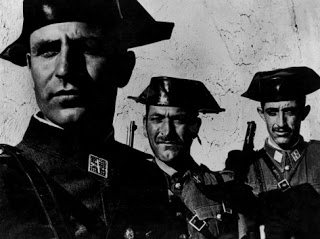
In 1974 I worked on a European tour of the band Traffic during which we did a gig in Barcelona.  This was shortly after the death of Franco, and in many ways Spain was still trying to get over that long period of fascism, and one relic of those bad old days was still very much in evidence, and still very much feared by all and sundry – for good reason.  The good old Guardia Civil was still there in that curious uniform, wandering around the place with their rifles.

We arrived at the place for the concert (I have no memory of its name, but it was some sort of old theatre that I do remember), and set up in the normal way.  Which means a lot of very hairy and tired men carting vast quantities of huge road boxes out of the  trucks and up about three flights of stairs, along long twisty corridors and finally out onto the stage.

Pretty no?
Pretty no?

Having more or less filled the stage with all those boxes, we set about putting in place all the speakers, lights, cables, sound mixers, amplifiers, lighting controls, drum risers and all the other arcane junk needed for a Rock and Roll concert that these boxes had contained.

All this was completely normal and SOP for us… what was slightly less normal for us was that this entire operation – which takes hours to complete – was all carried out under the extremely cold and disapproving eyes of an entire platoon of those Guardia creatures, who stared at us like hungry wolves as we worked and swore our way to getting it all ready.

Continue reading “One Of The Joys Of Being A Roadie – Machine Guns”

My first job in the theatre – Fly Man extraordinary

Many, many years ago, back in the mid ’60’s of the last century, the very first job I had in the theatre was as a fly man in a theatre in Streatham, a sort of suburb of South London, and in those far off days, an extremely working class area.  I have no recollection of the name of that theatre, but given that it was an old Victorian theatre, it was probably called something like The Streatham Palace, or the Imperial or some such over-blown name.

Anyhow, at the time I was an art student at the Croydon Art School, and needed some extra cash to live according to the level I felt I was entitled, so I duly managed to get that evening job in this theatre.

For those of you who haven’t a clue what a “fly man” does, well it is simple enough, we worked way above the stage in a system of walkways where we controlled all the bits of scenery and such like that needed to be raised and lowered during a show.   There was an impressive collection of ropes, pulleys and heavy steel counterweights, all of which we controlled by means of a number of brake levers and by simply heaving on the ropes at the correct moment, and lo and behold, a back drop would slowly descend onto the stage.. Or whatever the play called for.

Even given my lousy head for heights it was pleasant enough work, running around up there in the almost Stygian darkness doing our work merrily enough.  The only bit I wasn’t too happy about was the vertical ladder that I had to climb in order to get up there.. It was a hell of a long ladder, as the fly gallery was about 2 1/2 times higher than the opening of the stage for obvious reasons..

Curiously a fireman I happened to know had taught me how one went up a vertical ladder, so I at least had the right technique to help my vertigo.

I have almost no recall of the shows that took place there in my time, with the exception of a performance by the students at RADA (Royal Academy of Dramatic Arts) one of the main actor’s training colleges in London.

This was a performance of A Midsummer’s Dream, which among the other actors had a very young Ian McShane in one of the main roles.  In those days he was an insufferably arrogant young man – I am sure that with age has come a better grasp of how to behave, or at least I hope so for his sake.

Continue reading “My first job in the theatre – Fly Man extraordinary”