Borneo – Strange Place – Strange Reminders Of Time Past

Recently my wife had work for the Malaysian Ministry of Education, which entailed her dashing around Malaysia like a mad thing – a few days here, a few days there.  I accompanied her on her peregrinations of course, even though I had retired by that time, so I was a gentleman of leisure, and happily passed my time in these places writing a blog I had in those days, and gently absorbing the pleasures of the places we were in.

Two of these places really appealed to me – for different reasons.

Kutching:  Singapore as it was.

The first was Kutching in Sarawak.   A small but active little city on the banks of a river.  I was wandering around it on my first visit there, and had a strong feeling of deja vu, which to begin with I couldn’t understand.

Kuching Street Scene

And then it came to me.   Kutching today is almost exactly how Singapore was in 1950 when I lived there.   Generally low buildings, very dirty and cheerfully chaotic, each ethnic group living and working in their own section of the city and the greater part of the street commerce taking place on the street rather than closed-off in shops.   It was a strange and mildly disturbing experience finding myself back in the word I had lived in when I was about 9 years old.

And it brought home to me strongly how much Singapore has changed since it belonged to us Brits.   For the better?   Not sure.  In some ways, certainly, but at the cost of the loss of its character I feel.

Labuan – Small but fine

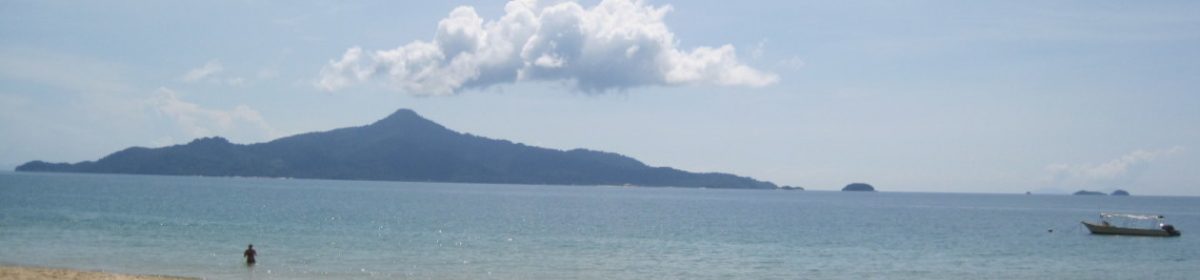
The other place that intrigued me was the small island of Labuan, which is off the north western tip of Borneo, and is chiefly notable for being a free port and for being in the middle of an oil field.

The first means that it is full of “duty free” shops, so a great place to buy booze and smokes, the second means it is entirely surrounded by drilling rigs and full of oil workers of all nationalities.

It also had it curious characters too.  We stayed in one hotel on the sea front, which was about 200 meters from one of the other main hotels there, which belonged to two very rich young men.  Each of whom had a luxury sports car, one a Lamborghini, the other a Ferrari, (or something similar, not very good on car models) which they kept parked on the forecourt of their hotel.  Each evening, at about 7 pm, they leapt into their respective cars, and with much roaring and spinning of wheels, drove to our hotel, where they spent the evening drinking gently and talking to their friends, and then at about 11 pm, they leapt back into their monster cars and roared back to their hotel.  As far as I could tell that was the extent of the use they put those two cars to.

The two sports cars..... with one of the proud owners
The two sports cars….. with one of the proud owners

I came across another intriguing thing there.  In the centre of the town is a small grass covered square, with two small stone monuments in the centre, the first a memorial to a Japanese General who died in a plane crash during the war, the second being a statement of imperial arrogance that I found quite breath-taking.

It stated that Captain so and so had arrived on this island in about 1828 (or thereabouts) and that he had claimed the island for Queen Victoria in the name of his Admiral.  Wonderful arrogance indeed, the damn place as already inhabited by its own owners after all.  Howsoever, it remained British until some time in the early 1950’s I believe.

The other curious thing was a small graveyard in the botanical gardens, which was reserved for pirates!

Odd place – the world.

Share with us:

If you have wandered in these two places and have any thoughts about either of them, do share them here with us.

Chinglish – One Of The Joys Of Living In China

While we were living and working in Beijing, I became totally besotted with the wonderful ways in which Chinese was often translated into English – Something we ex-pats called Chinglish, and which all of us loved with a passion, and made a hobby out of collecting examples of this form of English.

I shall probably post occasional small jewels of this art form for your pleasure, but here to start with is a sticker I saw in the back window of a very large SUV in Beijing.

BABY ON ROAD

Alarming I think you will agree……  (O:

Share with us:

Do you have any examples of this art form?  From China or anywhere?  Do share them with us here please to spread the joy.

Angola, Land Mines and Dead Tanks.

Some years ago My wife and I got work at an international school in Luanda (Angola).  A country that made a huge impression on us.
 

When we arrived in Angola, the civil war that had been raging in that country for about 30 years had just ended with the shooting to death of Savimbi – the leader of one of the three waring factions, (UNITA) and a sort of uneasy peace was being observed by all the various parties to that terrible war.
 
The end of Savimbi, and thus of the war
It had started as a war of independence against the Portuguese who had colonised the country in the late 19th century, and then once they had gone, it turned into yet another of those wars in which the USSR and the USA fought each other using surrogate armies. In this case it was the Cubans being the strong arm of the Russians, and the South Africans doing the USA’s dirty work for them.
 
The net result of all of this was a country that had an estimated 17 million land mines scattered around and endless shot up towns and villages, and a more or less totally destroyed infrastructure. Vast numbers of war injured people and an internal refugee problem of gigantic proportions – A real mess in other words.
 
In our work contracts with the International School of Luanda we were obliged to go away from the school compound during all our holidays, so most of our colleagues went off to South Africa, Namibia or further afield during the school holidays. Lotty and I on the other hand used those breaks mainly to explore Angola a bit, as Luanda itself is, or was, a horrible, slum ridden smelly dirty place. Relatively untouched by the war in the sense of not having any shot up buildings or other physical signs of the war, simply the millions of refugees living in unbelievable squalor around the city in vast slums.
 
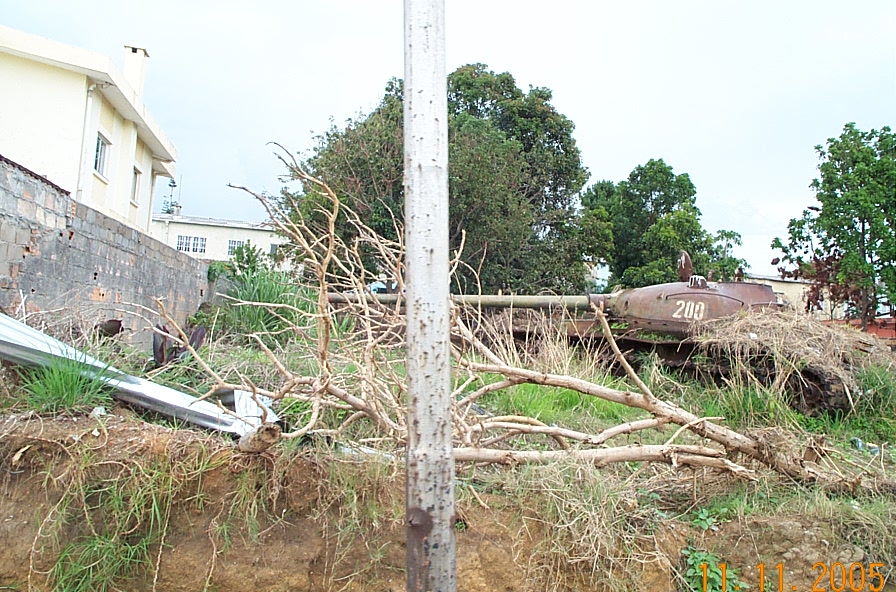
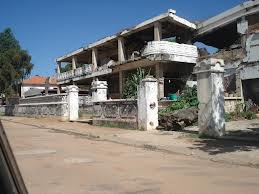
We went off to towns such as Huambo, Lobango and Benguela which showed us a very different side of Angola. Huambo was a rather pleasant small city up country, which hadn’t been particularly damaged by the war, even though it was the city that Savimbi used as his main base, so there were some sections that had been seriously bombed and damaged. Most notably the house where Savimbi had lived, this was a total ruin, with what was all too typical of Angola back then, several dead tanks in the garden. Angola was notable for an almost total lack of garden gnomes, but lots of burnt out tanks in people’s gardens instead.
 
Impressive what you can do with a heavy machine gun
Bigger and better than any garden gnome, a T60 tank in the back yard
Savimbi’s bombed house
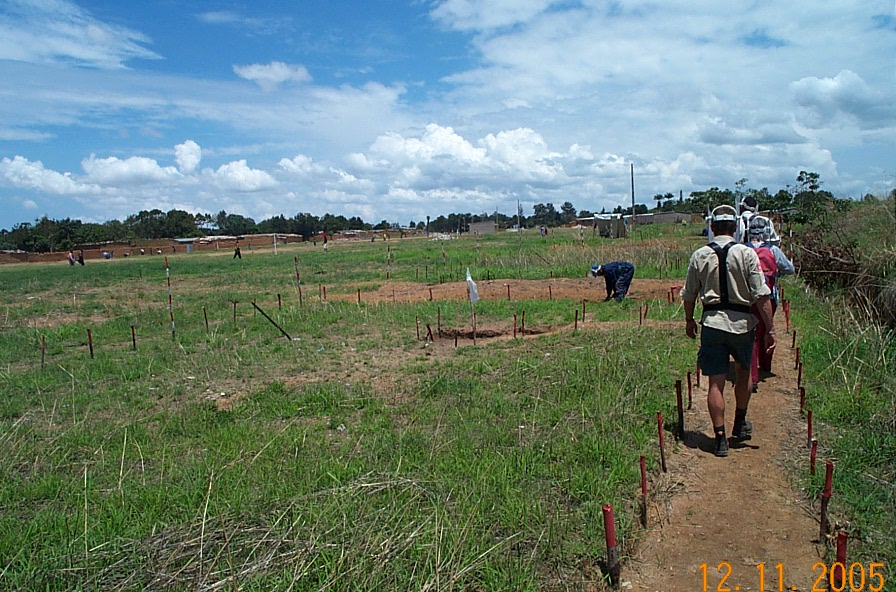
This was also the base from which the good folk of the Halo Trust set out to clear up all of those land mines the country was so plagued with. This work was being carried out by (among others) two young friends of ours from the UK, Nathaniel and Ali. So on one of our several visits to Huambo, they organised a visit to a mine field for us. This was in a small village nearby, where a largish mine field had been planted around a military base, just on the edge of the playground of the village school.


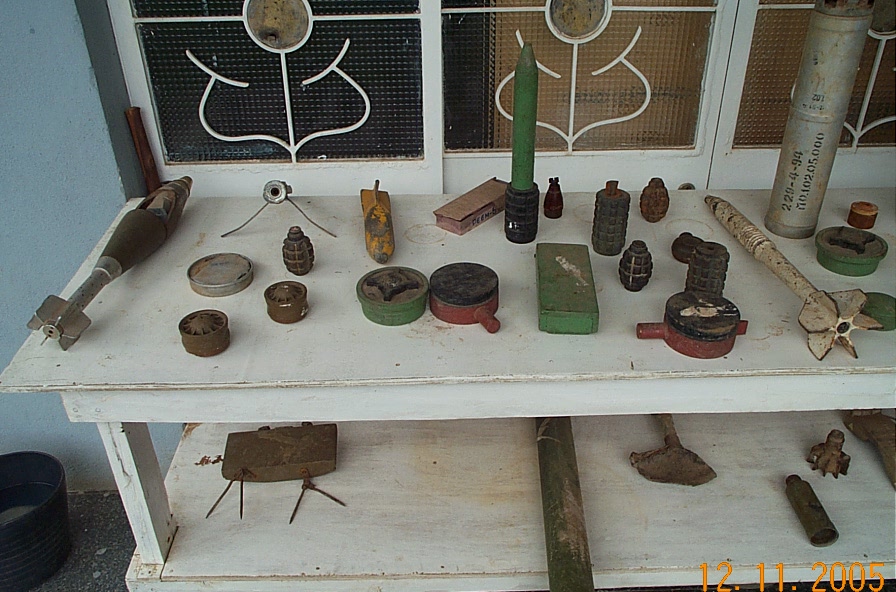
 What landmines actually look like….  Small and inoffensive mostly…  But……………………..
 
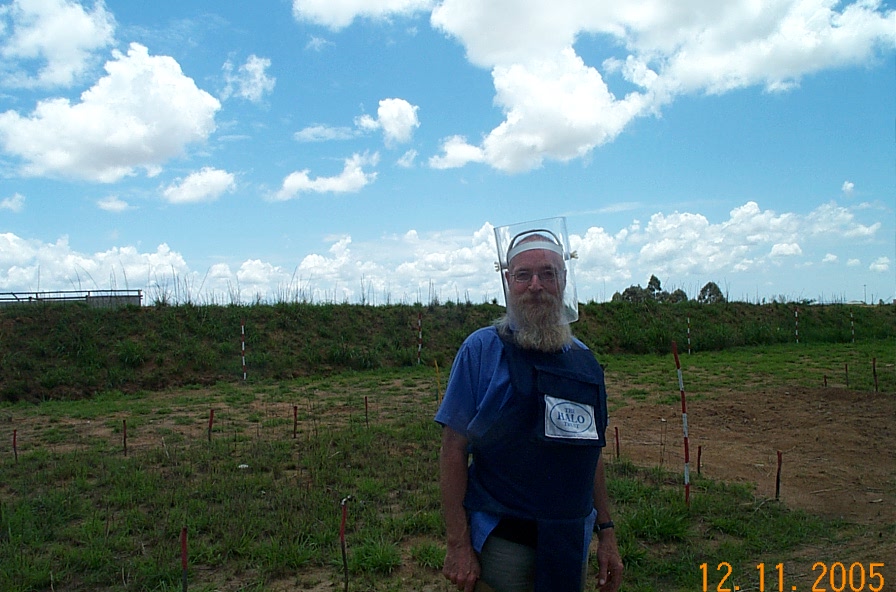
We arrived there and were taken under the arm of the Angolan guy who was in charge of this particular bit of mine clearing. He explained to us exactly the whats and hows of this particular mine field,and then kitted us out with the same sort of body armour that Princess Diana had so famously worn during her visit to these mine fields in Angola.
 
 
Us walking in the middle of the minefield
Me pretending to be Princess Diana – But in drag obviously
Another view of the minefield, the green bit is it.
Not surprisingly this armour is extremely heavy, hot and uncomfortable….. But thinking of the alternative made us extremely happy to be so protected. We also had the labourious process of mine clearing explained to us in fine detail. It is a very slow and painstaking process, and can only be done effectively by means of men digging narrow trenches through the mine field with small hand trowels, and thus locating each individual landmine, and removing it carefully and exploding it later in a pit.
 
We had earlier been shown some landmines, and the thing that stood out for me was how small they tended to be. Logical enough as the idea is not to kill but to maim. A dead soldier is sad, but not a problem, a severely wounded soldier on the other hand is lousy for moral, and requires other soldiers to help him to an aid station…
 
The only really effective way to clear mines, and this in a temperature in the high 30’s as well
 
Continue reading “Angola, Land Mines and Dead Tanks.”