A while ago I wrote a post about the depression period song Brother Can you spare a dime?, in which I played you a number of differing versions of this classic song. This evening while I was enjoying myself simply following the links on Youtube (as one does), going from one amazing bit of music to the next, I came across this version of that song sung by Dr John and Odetta which was so amazing I felt I had to add it to the blog.
The only thing to be said about it is that it is an astoundingly beautiful and moving version of the song and the way the two voices blend and flow is simply wonderful.
Anyhow, I have no desire to examine this version to death, but to simply let you listen to it and enjoy it as I did, so here it is for your pleasure.
So, did you enjoy that? I really do hope you did, and that you might even feel moved to leave a comment here telling me how you felt about this version of that song.
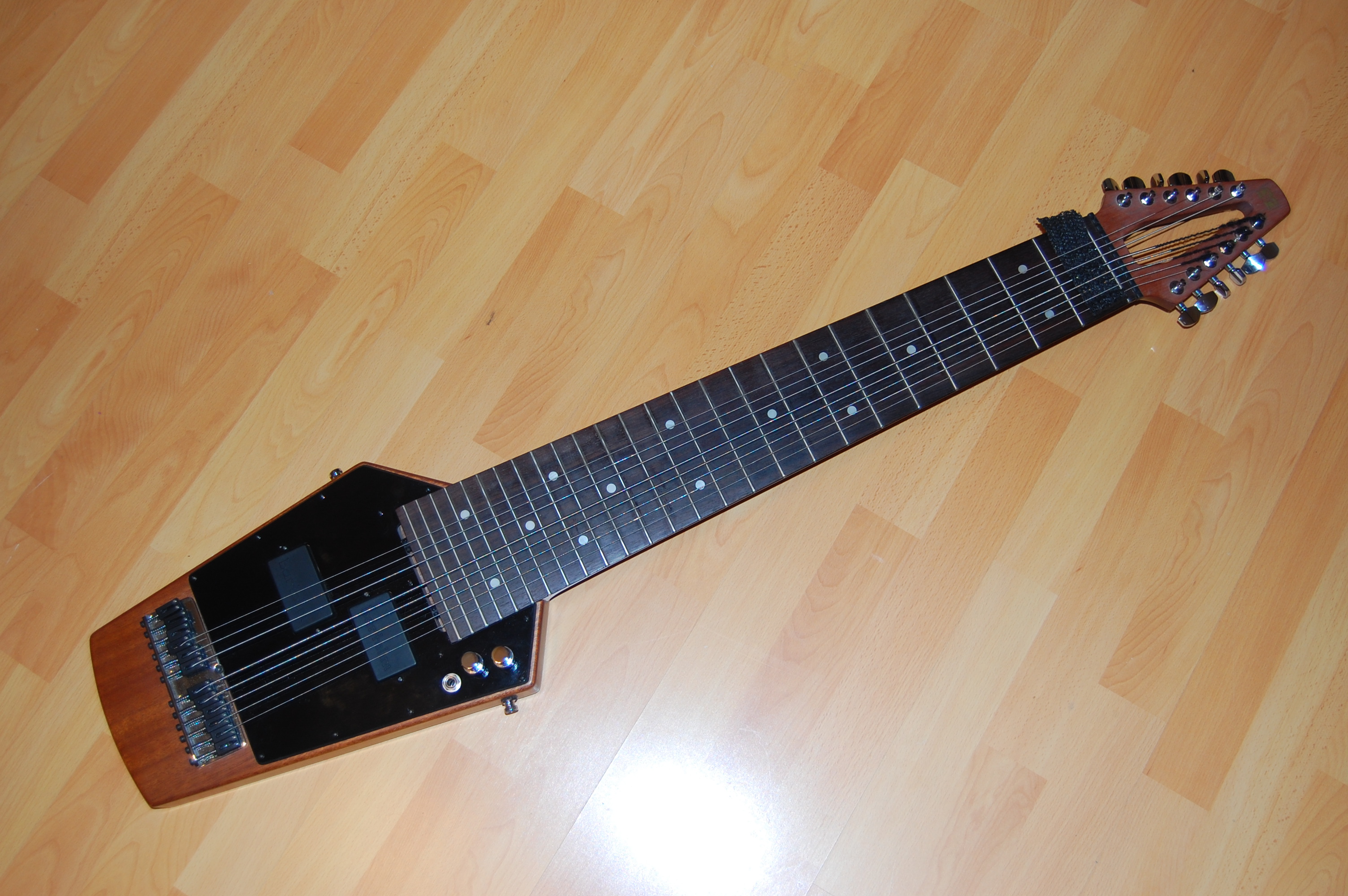
I came across the Chapman Stick a couple of days ago for the first time and fell in love with it at once. It is the most amazingly versatile and pleasing electronic instrument I have heard, one that is capable of being played in real time without any pre-programming of its various voices.
As you can see, it owes its form and to a lesser degree, its function to a simple electric guitar, but it is way more than that. Unlike a guitar, which is essentially a plucked string instrument, this one is much more a sort of keyboard in which the strings are hit rather than being plucked, though you can of course, pluck the stings if that is the effect you desire.
I think probably it would be best to show you a video made by the guy who invented the instrument, in which he describes in fine detail exactly what and how it works and is played. And for those of you who prefer to get your information by reading it, here is how good old Wikipedia describes it.
A Chapman Stick looks like a wide version of the fretboard of an electric guitar, but with 8, 10 or 12 strings. It is, however, considerably longer and wider than a guitar fretboard. Unlike the electric guitar, it is usually played by tapping or fretting the strings, rather than plucking them. Instead of one hand fretting and the other hand plucking, both hands sound notes by striking the strings against the fingerboard just behind the appropriate frets for the desired notes.
For this reason, it can sound many more notes at once than some other stringed instruments, making it more comparable to a keyboard instrument than to other stringed instruments. This arrangement lends itself to playing many lines at once, and many Stick players have mastered performing bass, chords and melody lines simultaneously.
So now you know what it looks like and roughly how it works, here is a video in which Emmett Chapman (the guy who invented this wonderful instrument) describes it, tells us how it works and demonstrates it as well.
See what I mean? Isn’t that the most amazing instrument you have ever heard? Such a versatile and intuitive instrument, and capable of so many different tones, colours and styles.
As you will see in the following videos, it is an instrument that lends itself easily to just about any sort of music you can think of.
As I wander through the depths of Youtube, hunting for bits of music to give me (and I hope, you) pleasure, I also come across some truly dreadful musical excrescences as you can probably imagine. So I thought I might collect some of them for your musical pleasure.
This wont be of the Portsmouth Sinfonia variety as they are not really simply making bad music, they are having fun making bad music and know perfectly well that is what they are doing. But the bits and pieces I shall be sharing with you are created by people who are labouring under the delusion that they are making beautiful and meaningful music.
So just to show you the difference, here is a video of the delightful Portsmouth Sinfonia and then one of the pieces that I consider to be truly lousy music.
Absolutely awful I agree, but done with love and pleasure, and no pretensions of being real musicians – They know they are dreadful and don’t care.
However, this next one is a very different kettle of fish, as you will hear.
Er…. That was someone called Nervous Norvus, with his truly strange song called, reasonably enough, Transfusion. I have no idea quite why anyone would want to make such a record, but he did, and apparently even managed to find people who wanted to buy it as well.
During the Great Depression there were really two songs that captured the spirit of the time. The first one I have already written about ( link to part one) in which I discussed and gave you various versions of the song “No one wants to know you when you are down and out”, so now I am going to have a look at the one that really does sum up the spirit and suffering of that awful time to perfection.
This is the well known song, Brother can you spare a dime?
Before I get into the many differing versions of this classic song, I should give you a wee bit of background to it. And who better to tell us what the song is really about than the guy who wrote the words – E. Y. “Yip” Harburg.
He had this to say about the purpose and message of this song, which by the way was actually written for a musical called Americana in 1930, just as the Great Depression was beginning to bite.
“I didn’t want a song to depress people. I wanted to write a song to make people think. It isn’t a hand-me-out song of ‘give me a dime, I’m starving, I’m bitter’, it wasn’t that kind of sentimentality”.The song asks why the men who built the nation – built the railroads, built the skyscrapers – who fought in the war (World War I), who tilled the earth, who did what their nation asked of them should, now that the work is done and their labor no longer necessary, find themselves abandoned and in bread lines.
It refers to “Yankee Doodle Dum”, a reference to patriotism, and the evocation of veterans also recalls protests about military bonuses payable only after 21 years, which were a topical issue.
So that is the background to this song, and to start us off I shall give you the best known and as near original version as there is, that being the version that Bing Crosby recorded back in the 30’s.
So as you can see, the guy is not really begging, he is saying what a huge contribution he made to things, and that now he has been dumped through no fault of his own. He still has his pride, but admits he needs help, but not as a beggar, but as an equal who is in temporary need. A powerful song.
The period of the Great Depression, which was roughly the 30’s of the last century, produced some remarkable music in a whole slew of styles. But one thing about almost all of this music was that it denied the realities of what was happening to the USA at that time. However, there were two songs that in their differing ways did describe the realities of what was happening to so many people in that financial crash.
And it is the the first of these two songs I shall be looking at in this post, the second (Brother Can You Spare A Dime) I shall look at in the next post. and here is the link to that one. (Click here)
1: No One Knows You When You Are Down And Out.
Even though I am relating this song to the Great depression, it was in fact written in 1923, by a blues guitarist called Jimmy Cox, and had nothing to do with financial crashes on a national level, but was all about what happens when you go from being very rich to very poor – Obviously a very different situation to the total financial collapse of an entire country, but there are obvious parallels to be seen in the basic idea of this song and the Great Crash of 1929.
The first known recording of this song was by Bobby Leecan with the South Street Trio in 1927.
As you have heard, his version is a bit different to the one we all know and love, but it is actually the original version, and as such, it deserves to be recognised and played. And to be honest, I like its simplicity and straightforward Blues approach to the idea.
Blind Bobby Baker, another moderately obscure blues singer also recorded it in the late 20’s (1927 to be exact), but he changed the words to emphasise the depressing side of the song’s message rather more forcibly.
So here is his version, played on a very old 78 as you can see.
I rather think that the title on the video, which refers to “nobody nees you” didn’t mean nobody knees you, but needsyou. Though when you think about it, both would work in the context of the song.
While I was working at the Roundhouse Theatre in London, we not only held Rock Concerts regularly, (see my earlier posts about them) but for a period, we also hosted a series of classical concerts. well, I use the term “classical” to differentiate them from the Rock Concerts, but in fact they were concerts made up of modern “serious” music.
What on earth do you call the contemporary equivalent of Bach and Wagner?
Whatever the correct term for this sort of music happens to be, the BBC had decided in its wisdom that they would broadcast a series of live concerts of extremely modern music under the baton of Pierre Boulez, who at that time (1974) was the resident conductor of the BBC Symphony Orchestra.
I am not sure why they had made this decision, except perhaps it might have been simply because Boulez was not only a conductor, but also a composer of such music, and a very active proponent of modern music.
Whatever the reason, a whole series of these concerts were put together and broadcast live from the Roundhouse over a period of several months.
Most of these concerts left me totally cold, as I have never been able to get into the more modern type of music.. all those plunks, squeals and roars simply fail to move me in any way – other than as far away from it all as I can get. Having said that, working with Boulez was an unalloyed pleasure. He was such a gentle person, totally lacking in the arrogance I found to be the norm with many of the other conductors I worked with over the years. All conductors (except Boulez) insist on being addressed as Maestro for some reason, but he didn’t. Well at least he never expected me to use that term, I always simply addressed him as Monsieur Boulez, and my technicians simply addressed him (to the total horror of the BBC guys and the members of the Symphony Orchestra) as Pierre. Which didn’t phase him one bit.
As I said, off stage he was a delightful and relaxed man, extremely easy to work with and simply a pleasure to be with. On stage however he was very different, still extremely civilised and polite, but meticulous and totally engaged in his work. A total professional in all respects.
As David Cameron announced his departure from office, he managed – by chance – to do something that actually produced some good. He hummed a jaunty little tune as he entered No. 10 Downing Street for the last time and this little hum has been taken by a number of highly creative people and turned into longer and actually rather good music, as you will see here.
Before offering you some of the better examples of this work,here is the unadorned original to set the scene as it were…….
OK, so that was how it went.
For some reason a lot of musical folk were inspired by that little bit of humming to take the hum and create much longer pieces of music based upon it, as in this example in which the composer feels that his hum was not so much a lament at the end of an unsuccessful political career, but actually a happy jig.
So, a relatively simple and straightforward version on an electronic piano/organ to show us how it might be done.
Other composers came up with much more complex versions of this little hum, as for example this rather amazing version by Jonathan Mul for harpsichord in the form of a Fugue on a Motif by David Cameron, as it rather grandly is called.
Wasn’t that beautiful? I don’t imagine that Cameron would have ever thought that he might be the cause of such a pleasingly gentle piece of music, but he was.
“National Anthems”, some are great and deeply moving, some are alright, but not really interesting, and most are simply dreadful. Banal words set to lousy, dreary “music”.
I was listening to what may well be the best national anthem ever conceived the other day and fell to wondering why so many were so bad. I have listened to dozens, read loads of more or less learned verbiage on the topic, but am not really any the wiser, except to note that both the words and music of most national anthems are put together very much on the cheap by people who have no obvious skills either as composers or as writers. This may be the simple reason.
So I thought I would have a serious look at some of them here, and play them to you to see what your thoughts on them might be. I shall start with ones that I consider to fall into the category of Great National Anthems, then have a look at a few that could be described as Acceptable National Anthems, and then, taking my courage in my hands, have a look at a few that come under the heading of God-Awful National Anthems.
Should be fun.
Great National Anthems:
As far as I am concerned, the South African National Anthem has to be the best, most emotionally powerful and uniting one. Conceived during South Africa’s dark days of Apartheid it brings together all the main language groups of that country, in a song that is both powerful, emotional and of course, patriotic in an acceptable manner. I will give you two versions of it, one recorded in a nearby country before the end of apartheid and the second at a rugby match once it had become the official anthem for South Africa. I think that both versions, in their differing ways, show what a national anthem should be remarkably well. Musically enjoyable, and also I believe the words are reasonable too, so here goes….. N’Kosi Sikeleli.
Now that is what I call one hell of a powerful national anthem!!!
That was recorded in Zambia, when it was obviously not possible to sing that song publically in South Africa, and now for the current version, but note how it still is able to invoke true emotion…
So, the bassoon… An instrument that a bit like the Cor Anglais tends to make people laugh rather than listen to seriously. This is a pity, as in fact it is an instrument that has considerable gravitas when needed as I hope to show you here.
What is a Bassoon?
Lets get this out of the way first, so we know what it is I am talking about. A definition of the bassoon would be as follows…….
The bassoon is a woodwind instrument in the double reed family that typically plays music written in the bass and tenor clefs, and occasionally the treble. The bassoon is a non-transposing instrument known for its distinctive tone color, wide range, variety of character and agility. Listeners often compare its warm, dark, reedy timbre to that of a male baritone voice. Someone who plays the bassoon is called a bassoonist.
So now you know what it is at least, now lets have a listen to what it actually sounds like to start us on our way.
That tiny extract from Prokofiev’s Peter and the Wolf, being Grandfather’s theme, gives a pretty good idea of the sound of this rather pleasing instrument. And as you can hear, nothing intrinsically funny about it either.
Hi, well I am still wandering around the deeper and odder depths of Youtube to see what I might stumble upon, and this time I have come up with a rich haul of musical oddities, well, not so much musical oddities as odd musical instruments, which of course means that the music is also rather odd.
I enjoy finding musical instruments that people invent for one reason or another, mainly I suppose because they desire a particular sound that no existing instrument is capable of giving them, and some of them are truly weird.
The first one is an enormous instrument called The Earth Harp, which is the invention of a curious bloke called William Close, obviously a man with one hell of a broad vision to life. I shall offer you two videos of this instrument, the first being from that tedious show called “….. Has Talent”, as in this video he gives a short explanation of the instrument, and then plays it to universal acclaim. The second video is someone else playing the Earth Harp at a TEDeX talk, so the instrument is properly explained, mostly in the “about under the video window if you watch the video on Youtube, rather than the somewhat showy approach used in the “America Has Talent” version.
I apologies for the long run in before we actually hear the instrument, but such is the way of such shows… Also for some reason whoever uploaded the video changed the format, so everyone is short and fat.. odd.
So here we go…………….
So, now you know roughly what it is all about, here is a different person playing it at a TedeX talk…



 OZTHOUGHTS