
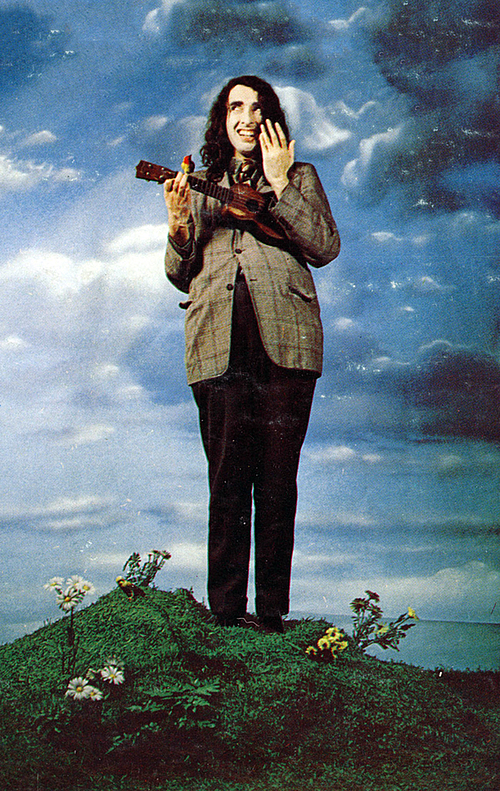
My Encounter With Tiny Tim… Very Odd…

Many years ago, about 1966 or thereabouts, I was asked by the Bonzo Dog Doo Dah Band (who were friends of mine) to do the lighting for their part in a concert that they were going to take part in at the Royal Albert Hall. This was to be a large scale concert, with a […]

Many years ago, about 1966 or thereabouts, I was asked by the Bonzo Dog Doo Dah Band (who were friends of mine) to do the lighting for their part in a concert that they were going to take part in at the Royal Albert Hall.

This was to be a large scale concert, with a load of bands and performers who were popular at the time, such as The Doo Dah Band as mentioned above, also The Small Faces, Joe Cocker and many others, and of course as you will have guessed from the title of this post, the extra-ordinary Tiny Tim.How Lighting worked at the Albert Hall.


Before I get onto Tiny Tim, I should mention how lighting was handled in the Albert Hall in those far off days before the advent of simple touring lighting control boards and rock tour lighting rigs.   Back then in halls such as the Albert Hall, one had to work with what they had rigged, and the actual control system consisted of huge mechanical dimmers down below in the cellars of the hall.   So “Lighting Directors” such as I had to sit upstairs in a small booth high above the audience with one of the Albert Hall electricians sitting beside me who had an old fashioned telephone to pass on to the guys in the cellar what I wanted to have happen with the lighting…

So for example I would ask for the main lighting to be dimmed to create a bit of atmosphere, this command was duly passed onto the electricians in the cellar, who then dashed around setting up the dimmers, so that on my word of command which would be relayed to them by the electrician sitting next to me, they could crank all those huge mechanical dimmers into their new positions, thus changing the lighting on the stage.

Cumbersome to say the least….

Anyhow, on the day of the concerts there was a general rehearsal of all the performers and their sound and lights people, including me of course.

There was also a small backing orchestra there for any performers who might need a bit of support – which included Cocker, and obviously, Tiny Tim.

Cocker did his rehearsal perfectly, not surprisingly  and in due time it was Tiny Tim’s turn.

He came slowly onto the stage with two “handlers” in suits, one of whom carried his ukulele for him.  They walked one on each side of Tiny Tim, each grasping him by his arms, and led him up to the microphone he would be using, and handed him his ukulele and stood a bit back from him.   The orchestra commenced to play his music, and at the right moment, one of his handlers tapped Tiny Tim on his shoulder, and like a sort of performing robot, Tiny Tim went into his act, which he did impeccably.

Then when he arrived at the end of his act, he simply stopped, and stood there immoveable.   His two handlers took him by his arms again, and started to lead him off-stage.   I was standing nearby as all this was happening, and as Tiny Tim was led of the stage, he asked in a sort of little boy voice  “Where are we going?”  to which one of his handlers replied in a gentle voice “we are going home Tiny, home….”   And off they went.

My overwhelming impression at the time was that he was a very sad and strange creature, and I have had no reason to change this impression since.   When you see interviews with him, and look at his very odd shape and appearance (the original pear shaped man), this feeling is only made stronger.   He was seriously odd, but when he wasn’t singing in that memorable falsetto, he actually had a very pleasing baritone voice, as you can hear of you check out an older post of mine in which I included a video of him singing “Brother, Can You Spare A Dime”  (Link to that post).

So to end this little bit of nostalgia, and to give you a better idea of what a curious and sad man he was, here he is in one of the many TV interviews he did after he ceased to be so famous..

An odd and sad creature.

The Ukulele – A Real Instrument Or Not?

If like me, you have probably never taken the ukulele seriously as a musical instrument, you might be surprised by the James Hill video below. I know that many musicians have played the ukulele and obviously regard it as a “real” instrument.  But I have always found it somehow to be lacking some quality that […]

If like me, you have probably never taken the ukulele seriously as a musical instrument, you might be surprised by the James Hill video below.

I know that many musicians have played the ukulele and obviously regard it as a “real” instrument.  But I have always found it somehow to be lacking some quality that is required for a musical instrument to be taken seriously.  I know that musicians as diverse as Tiny Tim, Kate Micucci (in her alter ego of Oates in the duo Garfunkel and Oates) have played the ukulele with total commitment, and obviously consider it to be a very real and worthwhile instrument.

And of course, famously George Formby strummed away on one as well.

But for me, it has always been a sort of pre-pubescent sort of an instrument. With its high, squeaky voice, and the strumming way it is normally played, it seemed to me to be simply a silly thing.

To demonstrate my point, here is good old Kate Micucci strumming away on her ukulele…….

As always with her, this song is of course rather surprising….   But that awful plunky ukulele!. Continue reading “The Ukulele – A Real Instrument Or Not?”

The Great Crash – Songs That Describe It. Pt 2

During the Great Depression there were really two songs that captured the spirit of the time. The first one I have already written about ( link to part one) in which I discussed and gave you various versions of the song “No one wants to know you when you are down and out”, so now I am going to have a look at the one that really does sum up the spirit and suffering of that awful time to perfection.

This is the well known song, Brother can you spare a dime?

Before I get into the many differing versions of this classic song, I should give you a wee bit of background to it.  And who better to tell us what the song is really about than the guy who wrote the words – E. Y. “Yip” Harburg.

He had this to say about the purpose and message of this song, which by the way was actually written for a musical called Americana in 1930, just as the Great Depression was beginning to bite.

“I didn’t want a song to depress people. I wanted to write a song to make people think. It isn’t a hand-me-out song of ‘give me a dime, I’m starving, I’m bitter’, it wasn’t that kind of sentimentality”.  The song asks why the men who built the nation – built the railroads, built the skyscrapers – who fought in the war (World War I), who tilled the earth, who did what their nation asked of them should, now that the work is done and their labor no longer necessary, find themselves abandoned and in bread lines.

It refers to “Yankee Doodle Dum”, a reference to patriotism, and the evocation of veterans also recalls protests about military bonuses payable only after 21 years, which were a topical issue.

So that is the background to this song, and to start us off I shall give you the best known and as near original version as there is, that being the version that Bing Crosby recorded back in the 30’s.

So as you can see, the guy is not really begging, he is saying what a huge contribution he made to things, and that now he has been dumped through no fault of his own.   He still has his pride, but admits he needs help, but not as a beggar, but as an equal who is in temporary need.  A powerful song.

Continue reading “The Great Crash – Songs That Describe It. Pt 2”